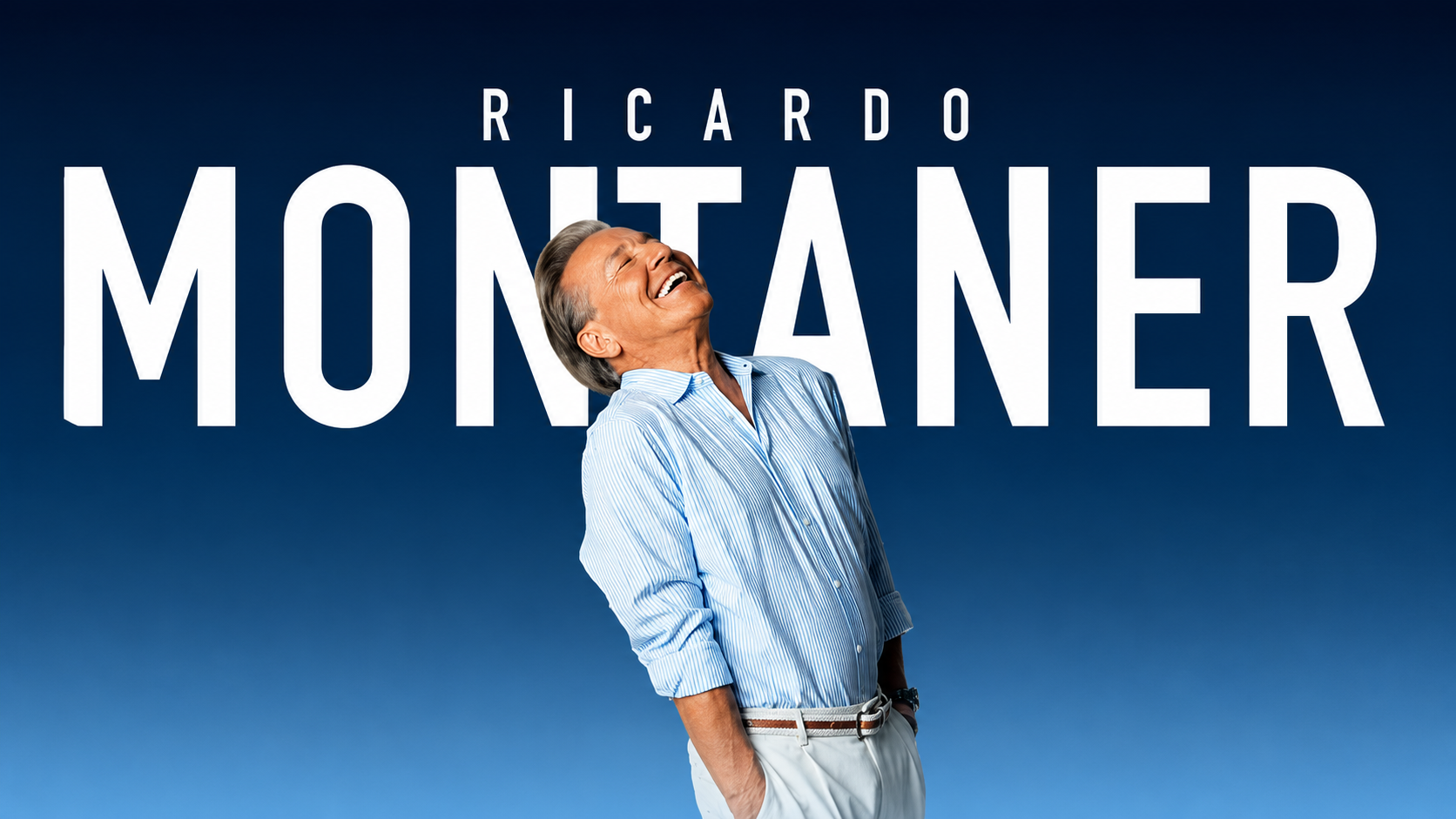
Talking about Ricardo Montaner means talking about one of those artists who become part of several generations' emotional memory. His voice has accompanied falling in love, weddings, separations, farewells, and those moments when a song seems to say exactly what we cannot explain.
But behind the singer of great ballads lies a much more human story. There is the Argentine child who came to Venezuela, the teenager who suffered insecurities and bullying, the boy who found refuge in a drum kit, the songwriter who wrote his first song inspired by his first love, and the man who ultimately built one of Latin music's best-known families.
When I think of Ricardo Montaner, I do not think only of the artist appearing before thousands. I think of the man who has made his memories, family, faith, and emotions an essential part of his career.
Who is Ricardo Montaner?
Ricardo Montaner was born as Héctor Eduardo Reglero Montaner on September 8, 1957, in Valentín Alsina, Buenos Aires province, Argentina. At six, he moved with his family to Venezuela and, after spending time in Caracas, settled in Maracaibo, Zulia state.
Although born in Argentina, Venezuela became essential to his identity. Montaner himself has said he feels deeply Venezuelan and especially Zulian. In his own manifesto, he defines himself in a way that perfectly sums up his story: born in Argentina, raised in Maracaibo, and residing in many Ibero-American hearts.
And that is important for understanding him. Ricardo did not simply arrive in Venezuela as a child: there he developed as a person, discovered music, and began imagining he could make it his life.
Ricardo Montaner's childhood: a story few know
Ricardo Montaner's childhood was not easy. Before becoming an international star, he lived in humble conditions and had to adapt to an entirely new country.
In interviews, he has recalled that during childhood his family lived in a boardinghouse and shared a bathroom with other families. The move from Argentina to Venezuela was not easy for him either. He had to adapt to a new school, new classmates, and even study the history of a country he had practically just discovered.
One of the most distinctive memories from that time involves his eyesight. Montaner has said he studied until the early hours and held his book too far away because he could barely see it. His mother discovered the problem and took him to a doctor, where significant farsightedness was diagnosed.
The glasses he had to wear became one of his greatest insecurities.
Added to that was uprootedness. Ricardo has said he began feeling different, gained weight, and suffered bullying. For a period of his childhood, he felt very insecure about his appearance and experienced a time he himself remembers as dark.
And here begins one of the most beautiful parts of his story: music ultimately helped him regain his confidence.
The drum kit that changed Ricardo Montaner's life
His father bought him a drum kit on credit, and that instrument ultimately became a kind of refuge.
Ricardo began playing in a band connected to the church. Drumming allowed him to feel safe because, as he has explained, he could stay behind the instrument without directly facing the audience.
Until one day, something unexpected happened.
The band's singer became ill, and Ricardo had to take his place as vocalist. What began as a substitution became a decisive moment. When he started singing and saw some girls in the audience smiling at him, he began to feel different.
Music restored the confidence he had lost.
It is one of those details in his story that makes me see Ricardo Montaner differently. Before becoming a symbol of Latin American romance, he was a boy who found in a song a way to feel good about himself.
His first song came from his first love
Ricardo began writing songs very young. At 14, he composed “Noches de primavera”, inspired by his first teenage crush. His own official site recalls that those first songs arose from the romantic impulse that would later become a permanent feature of his career.
It is curious to think that the man who would later write some of Latin America's most famous ballads began by doing exactly what so many teenagers do: writing about first love.
The difference is that he never stopped doing it.
From Héctor to Ricardo Montaner
Another little-known detail is that his stage name did not arise from a grand business strategy either.
During his first professional steps, he decided to adopt the name Ricardo and use Montaner, his mother's surname, to build his artistic identity. Thus was born the name by which he would later be known throughout Latin America.
In the late seventies, he began recording independently. His first work was “Mares”, while 1983 brought “Cada Día”, his first album with a major record company.
Yet the moment that would definitively change his career was still to come.
Ricardo Montaner's international breakthrough
The albums “Ricardo Montaner” and “Ricardo Montaner 2” were essential to his artistic growth. With songs such as “Yo que te amé”, “Tan enamorados”, “A dónde va el amor” and “Sólo con un beso”, he began winning over markets far beyond Venezuela.
“Tan enamorados” became one of those songs capable of crossing generations. And there began Ricardo Montaner's transformation into more than a successful singer: he became a voice associated with Latin American love.
Ricardo Montaner and his great songs
His repertoire is full of songs that became part of collective memory: “Tan enamorados”, “Me va a extrañar”, “La cima del cielo”, “Déjame llorar”, “Bésame”, “La gloria de Dios” and many others.
But what I really find interesting is that his songs are not only about falling in love.
They speak of missing someone.
Of losing.
Of waiting.
Of remembering.
Of asking for another chance.
Of staying when everything seems complicated.
That is why a Ricardo Montaner song can accompany someone for decades and take on a completely different meaning depending on their stage in life.
Ricardo Montaner and Marlene: a family story
In Ricardo Montaner's personal life, there is a name impossible to ignore: Marlene Rodríguez Miranda.
The couple married in 1989 and built a family that would become practically a small musical universe over time. Ricardo and Marlene have three children together: Ricardo, Mauricio, and Evaluna. Before his marriage to Marlene, Ricardo had two children, Alejandro and Héctor, with Ana Vaz.
Interestingly, the family also came to share a professional passion.
Mau y Ricky became a musical duo, and Evaluna developed her own career as a singer and artist. Héctor and Alejandro have also been involved in music.
It is difficult to separate Ricardo Montaner's artistic story from his family story.
Family is Ricardo Montaner's priority
Ricardo has spoken publicly about how important family is to him.
In an interview, he explained that he and Marlene have tried to instill in their children that family comes first, even when that means changing professional commitments. He also said he has sometimes avoided performances or blocked off dates to be present for important moments.
That says far more about the man behind the artist than any red-carpet photograph.
For Ricardo, professional success seems meaningful only if he can share it with his loved ones.
The Montaners' family gatherings
The Montaner family has also made its gatherings an important part of its public life.
Meals, barbecues, music, celebrations, and Christmas are part of that family dynamic. Different family members have publicly mentioned their intention to stay together on important dates.
And here is where you understand why the Montaners have such a distinctive image.
They do not seem to function solely as a family of artists.
They function as a family that also makes music.
Ricardo Montaner's faith
The Christian faith occupies an important place in Ricardo Montaner's life. From a young age, he was linked to church music and later spoke openly about his relationship with God.
An experience that deeply marked his spiritual life occurred when he visited a seriously ill baby during a trip to Montevideo. Montaner has said that situation profoundly affected his understanding of faith and life.
That is why, when we hear some of his spiritually themed songs, it is difficult to think it is simply an artistic strategy.
Faith is part of his personal story.
Tango and the return to his Argentine roots
Here we find one of Ricardo Montaner's most interesting aspects.
Although international audiences know him primarily for his pop ballads, tango had been present since childhood. His father and grandfather were important in that initial contact with Argentine music.
Many years later, Ricardo decided to return to those roots with his album “Tango”.
But the project meant much more than recording a different album.
It was a kind of return to childhood.
Montaner himself spoke about returning to places and memories of his childhood and reconciling with Ricardo as a boy. His friend Gerardo Rozín was also important in that process, taking part in the project's conception and dying before seeing it fully developed.
That is why “Tango” has special emotional weight within his career.
Gerardo Rozín and a friendship that left a mark
The relationship between Ricardo Montaner and Gerardo Rozín was much more than that of a singer and a journalist.
Montaner has said they became great friends after an interview and both he and Marlene developed a very close relationship with Rozín and his family. His death in 2022 affected him deeply.
The story behind “Tango” became inevitably linked to that friendship.
Ricardo lost a friend, but decided to continue the project they had imagined together.
And perhaps that is why the album has a much more personal dimension than it might seem at first glance.
Ricardo Montaner, the man behind the cameras
One thing that strikes me most about Ricardo is that his public personality seems closely connected to the person he shows in daily life.
He has not tried to hide the insecurities of his youth.
He has spoken about his complexes.
He has spoken about his mistakes.
He has spoken about his faith.
He has spoken about his children.
And he has also spoken about the losses that hurt him.
That creates a sense of closeness few artists manage to maintain after so many years.
More than four decades of music
Ricardo Montaner began his professional journey more than four decades ago. In his own manifesto, he recalls traveling Ibero-America for more than 45 years and never imagining that his teenage dream would reach such dimensions.
His career passed through different eras of the music industry: physical records, radio, television, music videos, mass concerts, and finally digital platforms.
And he managed to survive all those changes.
That does not happen solely through having a good voice.
It happens when there is an authentic connection with audiences.
Ricardo Montaner and new generations
One of the great proofs of his continuing relevance is precisely his ability to connect with young artists.
His own family belongs to a different musical generation, and Ricardo has supported that process without trying to compete with his children. On the contrary, he has become a kind of reference figure within that new generation of Latin American artists.
His legacy is no longer only in his records.
It is also in the songs and careers of those who grew up listening to him.
Ricardo Montaner in 2026
And here is one of the best proofs that the story is not over yet.
In 2026, Ricardo Montaner continues performing live on an international tour. His official site lists tour dates in Argentina, Uruguay, Costa Rica, Colombia, Mexico, Ecuador, Peru, Chile, and Paraguay, among other destinations, with numerous concerts marked sold out.
It is impressive to think of the distance between the boy who played drums to hide his shyness and the artist who, decades later, returns to international stages.
The career took many turns.
But the starting point remains the same.
A boy with a song.
Ricardo Montaner's legacy
If I had to explain what makes Ricardo Montaner special, I would not speak only of his awards, records, or millions of followers.
I would speak of lasting presence.
Some songs are successful for a moment and then disappear.
Montaner's did something different.
They stayed.
“Tan enamorados” can remind us of a first love. “Me va a extrañar” can take us to a separation. “La cima del cielo” can transport us to another era. “Déjame llorar” can awaken memories we thought forgotten.
That means his songs stopped belonging solely to the artist.
They became part of the lives of those who heard them.
My view of Ricardo Montaner
If I had to describe Ricardo Montaner from a close perspective, I would say he is a man who never completely left behind the child he was.
The child who came to Venezuela.
The one who felt different.
The one who suffered bullying.
The one who hid behind a drum kit.
The one who wrote a song for his first love.
That child still appears in the man who talks about his family, remembers his Argentine roots, returns to tango, and keeps believing a song can touch someone's heart.
And perhaps that is why his songs feel so human.
Because behind each one is a story.
Ricardo Montaner: much more than a romantic singer
Ricardo Montaner was born in Argentina, grew up in Venezuela, and became one of Latin American music's most recognizable voices.
But his story cannot be summed up simply by saying he is a romantic singer.
He is also a father, husband, grandfather, songwriter, musician, man of faith, and artist who has stayed relevant across generations.
His story is made of migration, insecurities, music, love, family, loss, faith, and perseverance.
And after so many years, I think that is the real reason Ricardo Montaner remains special.
He does not sing only about love.
He sings about what happens to us when we love.
And that difference is enormous.
Because a song can be famous.
But when a song accompanies you through part of your life, it stops being just a song.
It becomes a memory.
And Ricardo Montaner has built an entire career turning feelings into memories.