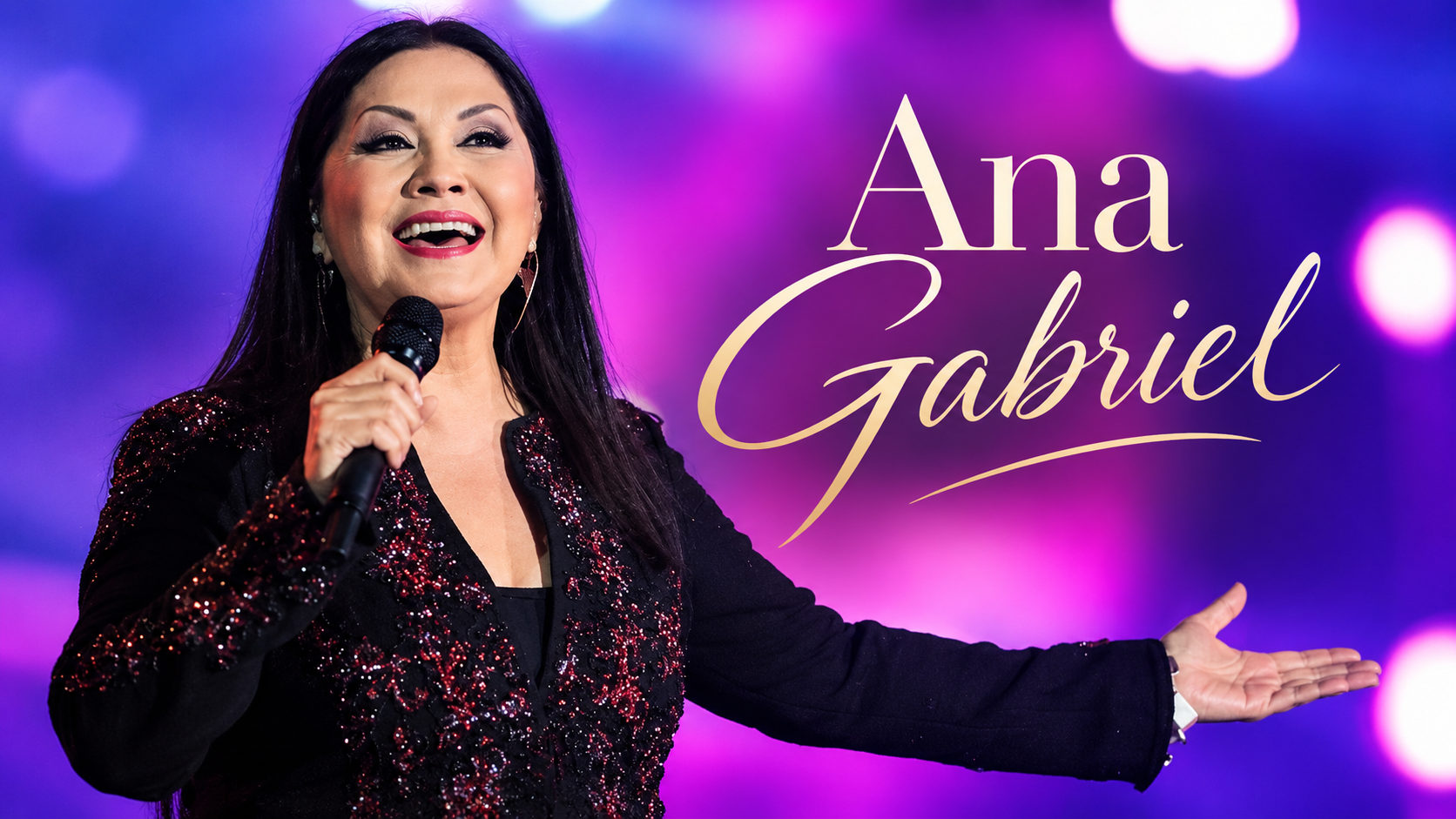
To speak of Ana Gabriel is to speak of a woman who never learned to sing halfheartedly.
When I think of her, I do not think only of the artist who appears onstage.
I think of that strong-willed woman, with a serious look when something displeases her and an enormous sensitivity she has always known how to hide behind a firm personality.
María Guadalupe Araujo Yong, whom the world came to know as Ana Gabriel, was born in Guamúchil, Sinaloa. From a very young age, she felt music was part of her.
She began singing and writing her own songs when she was just a child, influenced by the music she heard at home. Over the years, that interest became a calling and then a career that would span generations.
I have always thought there are artists who perform songs and others who seem to have lived them before singing them. Ana Gabriel belongs to the latter. When she sings about a disappointment, a farewell, or a love that could never be, it is hard to imagine she is simply performing lyrics. She has a very distinctive way of inhabiting every word and making it seem as though she is telling you something that happened to her, or that has just happened to you.
Her career began in Tijuana in 1974, and a few years later she definitively adopted the stage name Ana Gabriel. In 1984, one of the important opportunities of her early years came when she participated as a songwriter in the Festival Valores Juveniles.
Then came hits, albums, and stages that would gradually turn her into an essential figure in Latin music.
But there was one moment that especially shaped her path. In 1987, she won the National OTI Festival with “Ay amor” and took third place in the International OTI held in Lisbon. For an artist still building her name, that meant opening a path far beyond Mexico.
And then came those songs that no longer need an introduction.
“Quién como tú,” “Ay amor,” “Simplemente amigos,” “Y aquí estoy,” “Cómo olvidar,” “Es demasiado tarde,” “Mi talismán,” and so many others became part of the emotional memory of millions of people. The Sociedad de Autores y Compositores de México specifically recognizes those songs among the works that have brought her the greatest satisfaction throughout her career.
The curious thing about Ana Gabriel is that she never needed to become someone different to remain relevant. While many trends came and went, she kept being herself. Her raspy voice, her way of performing, and that blend of ballad, pop, and Mexican music became her signature.
I remember that one of the things that most catches my attention about her is that behind that strong image is a woman far more spontaneous than many imagine.
During her performances, she has revealed a very distinctive sense of humor and a direct personality, the kind that does not need to dress up its thoughts too much. At a performance in Monterrey, for example, besides singing her greatest hits, she surprised the audience with her good humor and even took the time to attend to people approaching the stage to ask for autographs.
Ana Gabriel also learned to live with something that often accompanies major stars: rumors. For years, her personal life sparked curiosity and generated stories that grew around her songs. One of the best-known examples was everything surrounding “Simplemente amigos” and speculation about a supposed dedication. In 2024, she herself clarified that the song was not written for the person who had been mentioned for years as its inspiration.
And that says a great deal about her way of dealing with fame. Ana Gabriel has allowed the public to know the artist, but she has never felt obliged to share every detail of her private life.
Her career also speaks for her. She has received important honors, including several Premios Lo Nuestro and various nominations at international awards. In the nineties, she even set important records within those awards, and her name became a constant presence in Latin music.
At the Grammy Awards, she was nominated in 1991 for the album “Quién como tú” in the Best Latin Pop Album category. Throughout her career, she also received Latin Grammy nominations.
But awards, though important, do not explain why Ana Gabriel remains in so many people’s hearts.
Her songs explain that.
Because there are women who sang her songs while cleaning the house. Men who listened to them after a breakup. Couples who made them part of their story. People who found comfort in lyrics when they did not know how to explain what they were feeling.
That is Ana Gabriel’s true legacy.
She did more than build a career. She built a collection of memories for millions of people.
And after so many years, I still think that is the best way to understand her. Not as a distant star, but as that friend who appears when you need to say something painful and cannot find the words. A friend who, instead of giving you advice, plays you a song and seems to say: “I have been through that.”
That is why Ana Gabriel continues to be Ana Gabriel.
The firm voice. The intense woman. The sensitive songwriter. The artist who turned heartbreak, nostalgia, and love into songs that refuse to grow old.
And perhaps that is why, whenever one of her songs starts playing, you stop what you are doing and listen.
Because some voices simply sing.
Ana Gabriel’s reminds you of what you once felt.