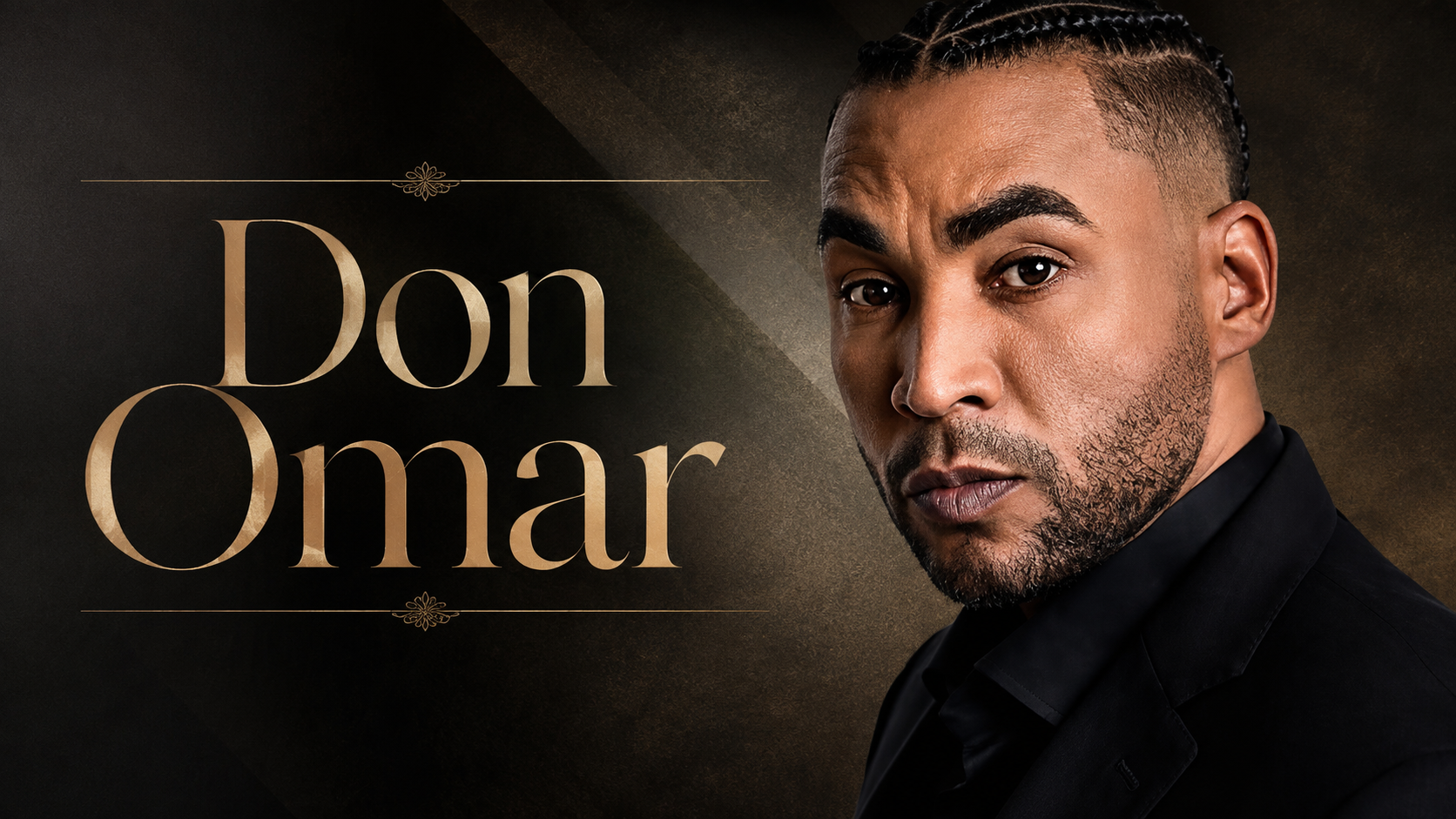
Talking about Don Omar means talking about a time when reggaeton was still searching for its place in the world. Before the genre became an international industry, William Omar Landrón Rivera was already championing music that many still viewed with prejudice. And if I have learned anything from getting to know Don Omar's story, it is that behind the strong, elegant, confident persona we see onstage, there has always been a man full of contrasts.
Don Omar was born on February 10, 1978, in Santurce, Puerto Rico, and grew up in Villa Palmeras. He began writing songs and poems at a very young age. But his path was not that of an artist who simply dreamed of becoming famous and achieved it. Before becoming one of reggaeton's most important figures, he was a church pastor and devoted several years of his life to preaching.
That chapter of his life says a lot about him. Don Omar has always had a very particular relationship with spirituality, his mistakes, and the need to find a purpose. His story is not perfect, and that is precisely what makes it interesting.
From church to reggaeton
When Don Omar began fully embracing urban music, many still saw reggaeton as a marginal genre. He himself has said that when he started, this music was practically considered forbidden in some circles.
His professional entry into the urban music movement came in the early 2000s. Héctor El Father recognized his talent, and Don Omar began gaining ground as a songwriter and performer. He even took part in important projects before becoming a solo artist.
And then came 2003.
That year saw the release of The Last Don, the album that completely changed his life. Songs such as Dale Don Dale, Dile, and Intocable took his name far beyond Puerto Rico. The album ultimately became one of the essential works of that first international generation of reggaeton.
King of Kings and the birth of a legend
If The Last Don introduced him to the world, King of Kings confirmed that Don Omar was here to stay.
Released in 2006, the album debuted at number one on Billboard's Latin charts and reached number 7 on the Billboard 200, a historic position for a reggaeton album at the time.
There we find songs that helped define a generation. Angelito showed his more sentimental side, while other tracks retained the blend of sensuality, street life, and melody that ultimately became his hallmark.
What has always struck me about Don Omar is that he never needed to confine himself to a single formula. He could make a dance song, a story of heartbreak, or a thoroughly commercial collaboration, and still sound like Don Omar.
The artist who also wanted to tell stories
Don Omar did not stay solely in music.
His role in the Fast & Furious franchise as Rico Santos brought him even closer to international audiences. He appeared in five films in the series, and several of his songs also became part of that cinematic universe.
And here is something I find important. For Don Omar, film was not simply a way to capitalize on his fame. It was another way to express himself and expand what he could do as an artist.
Danza Kuduro, with Lucenzo, ultimately became one of those phenomena that no longer belong to just one singer. It is a song that practically became part of Latin popular culture over the last decade.
The man behind the persona
There is a part of Don Omar that often remains hidden behind the lights, cars, stages, and major productions.
In an interview with Rolling Stone, he said he had become exhausted after spending years practically touring every weekend. In 2017, he announced his retirement and explained that he needed to reclaim time for his family.
And here emerges a side of Don Omar that many perhaps had not imagined.
For a while, he stepped away from the stage and devoted himself to working on a farm in Puerto Rico. He learned about agriculture, planting, and cultivation, even with help from students at the University of Puerto Rico. That experience ultimately led him to create a business connected to organic products.
I like that part of his story because it shows that behind the King is also a man who needed to stop, breathe, and reconnect with himself.
A complicated relationship with fame
Don Omar has never hidden the fact that fame has also brought him difficult times.
He has spoken publicly about disappointments, people who stayed close to him out of self-interest, and situations that ultimately affected the way he related to others.
Over the years, he seems to have learned to be much more selective about the people in his circle.
In an interview, he explained that one of the things he was most grateful for was learning who his real friends were and who were not.
I think that is one of Don Omar's great transformations. The young man who wanted to conquer the world with a song ultimately became a man much more aware of the price of living permanently in the spotlight.
Don Omar and his way of reinventing himself
After many years in his career, Don Omar has continued to show that he does not want to live on nostalgia alone.
In 2023, he released Forever King, an album that mixed reggaeton with elements of salsa, cumbia, mambo, and other sounds. The artist himself explained that he wanted to grow and experiment without losing what his fans recognize as his essence.
I find that essential to understanding his career.
Don Omar did not get this far simply because he had hits. He got here because he knew how to evolve.
He has changed his sound, collaborated with different generations, entered film, created businesses, and learned to step back when he needed to.
A new chapter
In recent years, Don Omar has also faced one of the hardest trials of his life. In 2024, he publicly revealed that he had been diagnosed with kidney cancer and later announced that he had overcome the disease.
Far from hiding what happened, he decided to speak about it publicly and turn that experience into one more reason to appreciate life.
In 2026, as he remains active and prepares new projects and performances, he has spoken of this chapter as an opportunity to be thankful for being in front of his audience again.
And perhaps that is why listening to Don Omar speak feels different today.
He is no longer just the man who wanted to be the king of reggaeton.
He is a man who has experienced success, disappointment, change, loss, moments of silence, and new opportunities.
Don Omar's legacy
Looking at everything that has happened with reggaeton over recent decades, it is impossible not to recognize Don Omar's place in it.
Before the genre dominated digital platforms and major international stages, artists like him had to prove that this music could go much further than many imagined.
The Last Don, King of Kings, iDon, Meet the Orphans, The Last Don 2, and his later works are part of a career that helped build the urban sound we know today. His official discography continues to bring together those projects and various collaborations that have marked his career.
But if I had to choose one thing about Don Omar, it would not be just his awards, songs, or records.
I would choose his ability to get back up.
Because behind the King of Reggaeton is a man who had to learn to lose, start over, step away when necessary, and return when he felt ready again.
And perhaps that is his true legacy.
Don Omar not only helped take reggaeton to the world. He also showed that an artist can change over the years while remaining faithful to his roots.
For me, that is the difference between someone who simply had a period of success and someone who truly leaves a mark.
Don Omar belongs to that second category.