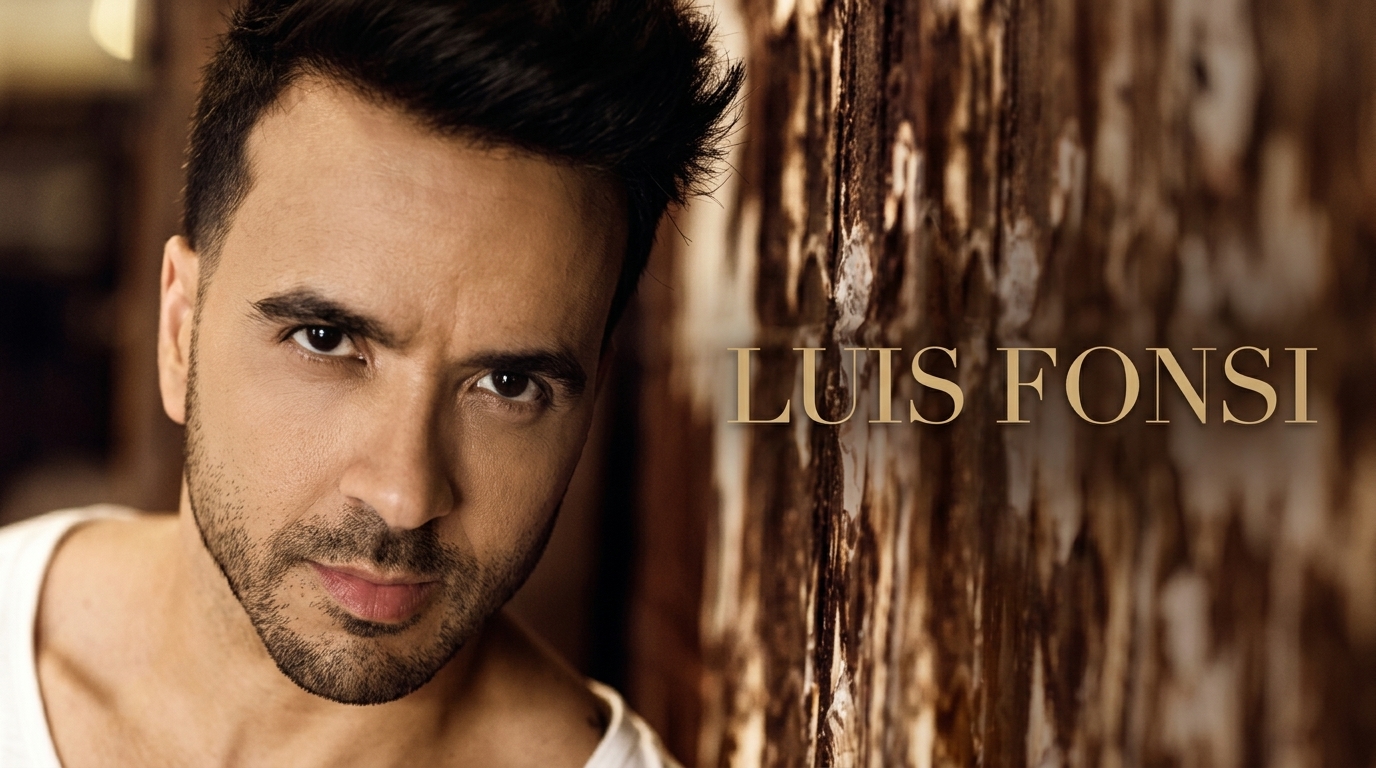
There are artists you feel you know even if you have never had the opportunity to sit down and talk with them. Luis Fonsi is one of those cases. After so many years listening to his music, watching his interviews, and following the different moments of his career, it is easy to understand that behind that elegant, calm image is a tremendously disciplined, family-oriented man who is in love with music.
When “Despacito” appeared in 2017, a great many people discovered Luis Fonsi as though he had just arrived. But those of us who had followed his career knew he was no newcomer. By then, he had spent nearly twenty years building a career that officially began in 1998 with the album “Comenzaré.” Before becoming one of the best-known Latin artists on the planet, Fonsi had already traveled a long road as a singer, songwriter, and performer of ballads and pop.
A boy who found his place in music
Luis Alfonso Rodríguez López-Cepero was born on April 15, 1978, in San Juan, Puerto Rico. From childhood, he had a very natural relationship with music. He liked to sing, imitated artists, and participated for several years in the Coro de Niños de San Juan. When he was around ten, his family moved to Orlando, Florida, an important change that did not pull him away from his true calling.
As a teenager, he continued singing and belonged to a vocal group called Big Guys.
He also pursued his musical training quite seriously. In 1995, he received a scholarship to study at Florida State University, where he specialized in vocal performance and studied subjects related to singing, music theory, and composition. That explains much of what followed, because Fonsi has never been just a beautiful voice. There is training behind that voice.
And I think that is precisely one of the keys to understanding him. Fonsi did not come to music by chance. From a very young age, he seemed clear that singing was more than a hobby. It was the path he wanted to follow.
Before Despacito, there was already a story
His first album, “Comenzaré,” arrived in 1998. Then came works such as “Eterno,” “Amor Secreto,” “Abrazar la Vida,” and “Palabras del Silencio,” establishing him particularly among Latin audiences.
During those years, he built an identity very different from the one he would later show the world with “Despacito.” This was the Fonsi of romantic songs, intense lyrics, and that way of singing that seemed made to speak directly to someone.
Songs like “Imagíname sin ti,” “No me doy por vencido,” and “Aquí estoy yo” helped make him one of the most important names in Latin pop. And there is something that has always caught my attention about his career: he never seemed to need to erase his past to reinvent himself. Rather, he kept adding new stages.
That matters because “Despacito” did not come to save a career. It came to transform a career that was already fully established.
Despacito and the phenomenon that changed everything
In 2017, something happened that very few artists get to experience. Fonsi released “Despacito” with Daddy Yankee, and the song became a worldwide phenomenon. Then came the remix with Justin Bieber, and that song born out of Latin music began dominating markets where Spanish was not the main language.
“Despacito” stayed at number one on the Billboard Hot 100 for 16 weeks and became one of the biggest phenomena in Latin music history. It also earned important honors, including four Latin Grammys, with Song of the Year and Record of the Year among them.
But there is something I find even more interesting. After such success, Fonsi did not settle into living off a single song.
Instead of endlessly repeating the formula, he kept working and exploring different possibilities. The album “Vida” confirmed that he could make the most of “Despacito”’s popularity without becoming trapped by it. He also collaborated with artists of very different styles, showing that his voice could adapt to other musical worlds. Throughout his career, he has worked with names such as Christina Aguilera, Juan Luis Guerra, Justin Bieber, Demi Lovato, Ozuna, Laura Pausini, Eros Ramazzotti, and Rauw Alejandro.
Luis Fonsi’s personal side
And this is where I feel the artist becomes easier to understand.
Fonsi has always shown a very close relationship with his family. He is married to Spanish model Águeda López, and they have two children, Mikaela and Rocco. Both were born on December 20, a rather curious family detail that has been shared publicly in various interviews and media outlets.
His relationship with Águeda began around 2010 and, as they themselves have recounted, after meeting they began communicating until the relationship grew. They married in 2014 in California, in an intimate ceremony.
When you hear Fonsi talk about his family, a very different side emerges from the man we see onstage. He himself has acknowledged that one of the greatest challenges of his life has been finding a balance between his career and his role as a father. He has spoken publicly about how difficult it has been to miss important moments in his children’s lives because of his professional commitments.
Personally, that seems to me one of the most human aspects of his story. Because behind the awards, the planes, the stages, and the songs heard by millions of people, there is also a man who knows success has a price.
An artist who still enjoys discovering new paths
Another thing I like about Fonsi is that he does not seem to settle.
In 2024, he presented “El Viaje,” an album built around cities and places with special meaning in his personal and artistic journey. Songs like “Buenos Aires,” “Santiago,” “La Romana,” “Marbella,” and “Roma” form part of that idea of turning his years in music into a kind of emotional map.
And there is something very beautiful behind the concept. Fonsi explained that he did not simply want to make songs about cities, but to use those places as part of stories and experiences. Even “La Romana” has family significance because his grandmother was Dominican, and he decided to use bachata as a way of paying tribute to her.
I think it is an intelligent way of looking back. Instead of dwelling on recounting what he had already done, he turned his memories and travels into new music.
Luis Fonsi in 2026
And the story has not stopped.
Fonsi’s official website shows that during 2026 he has continued releasing music, including “Cambiaré” and, more recently, “Me Despido,” released in August 2026.
Additionally, this September he took another interesting step by making his acting debut in the film “Say A Little Prayer,” released on Netflix in the United States on September 3, 2026.
In the film, he plays Rafael Reza and also participates in the soundtrack.
That demonstrates something repeated throughout his career: Fonsi keeps seeking new ways to express himself.
What Luis Fonsi truly represents
For me, reducing Luis Fonsi to “the singer of Despacito” captures only a small part of his story.
Fonsi represents the artist who had patience. The young man who left Puerto Rico, moved to Florida, studied music, began with a guitar and a dream, knocked on doors, and built his name little by little. He himself has said he started from the bottom, without a famous surname or a band to open the way for him.
He also represents the artist who knew how to reinvent himself without giving up who he was.
He can sing a ballad, a pop song, an urban collaboration, or a bachata and still sound like Luis Fonsi. That identity is probably one of his greatest strengths.
After so many years, awards, albums, travels, and stages, he still retains something that is hard to manufacture: the sense that he truly enjoys singing.
And perhaps that is why he continues to connect with so many people.
Because before being the voice of “Despacito,” Luis Fonsi was already a singer who had spent years speaking to audiences about love, loss, hope, and second chances.
“Despacito” turned him into a worldwide phenomenon.
But his true story began much earlier.