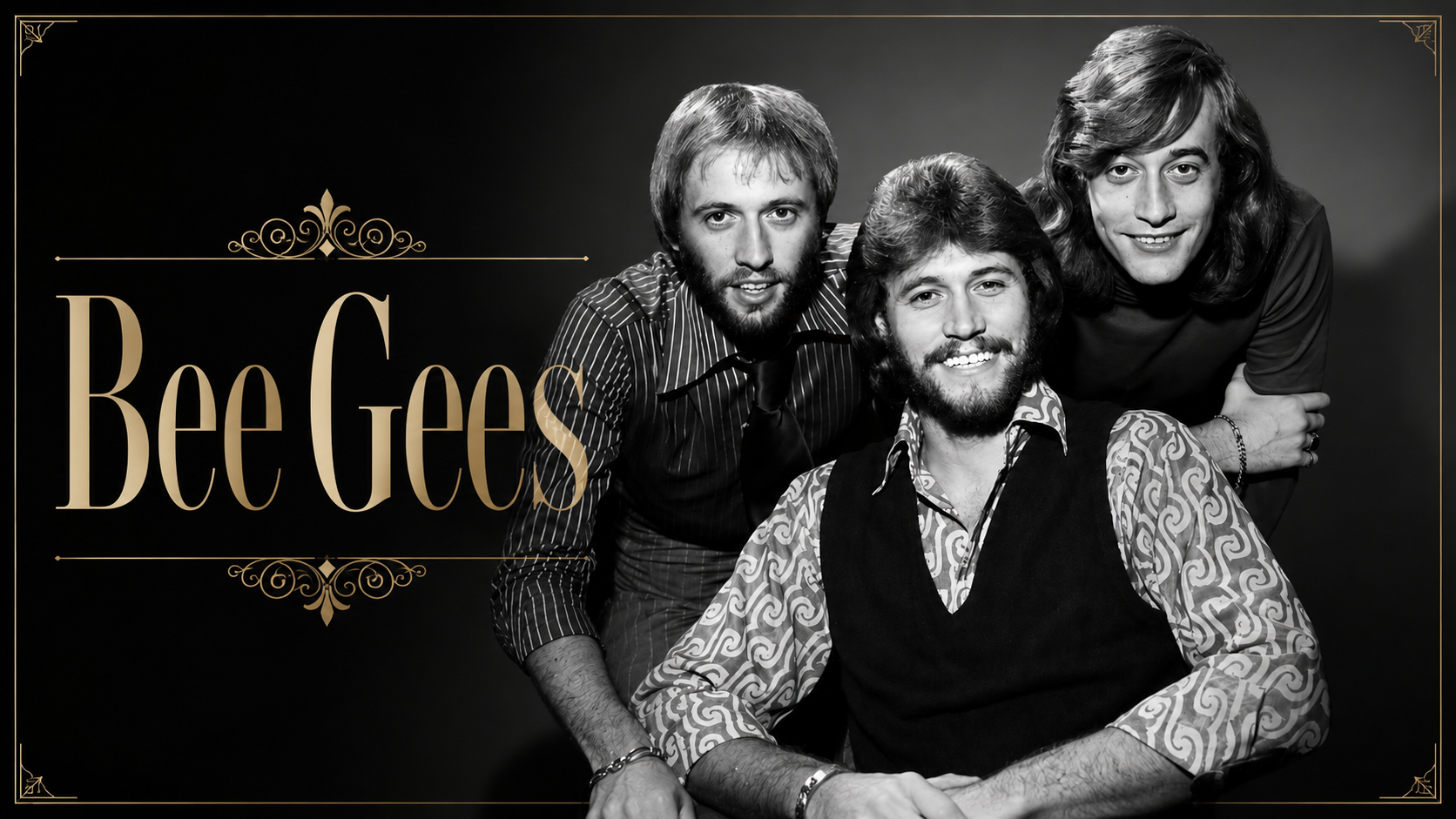
Talking about the Bee Gees means talking about one of popular music's most interesting stories. Barry, Robin, and Maurice Gibb not only formed one of the most successful groups of all time; they also built a career filled with great songs, changes in style, difficult moments, and a musical connection that made them unique.
When I think of the Bee Gees, the first thing that comes to mind is how their voices could blend. There was something special about those harmonies, especially when all three sang together. That quality began long before the major stages and records that ultimately sold millions.
The childhood of Barry, Robin, and Maurice Gibb
Barry Gibb was born in 1946 on the Isle of Man, while twins Robin and Maurice were born in 1949. From childhood, they grew up surrounded by music. Their father, Hugh Gibb, was a musician who worked as a bandleader and drummer, so the brothers were exposed to instruments and songs from a very early age.
The three began singing together as children. They did not have many resources and, according to stories from those early years, even used improvised instruments while imitating the artists they heard.
The Gibb family moved to Australia in 1958. There, the brothers began performing on small stages and in different places where they could play. It was a very different time from the image audiences would later have of them, but it was precisely there that they began gaining the experience they would need to become professionals.
How the name Bee Gees came about
Before becoming known as the Bee Gees, the brothers performed under several names. These included The Rattlesnakes, Wee Johnny Hayes and the Bluecats, and BG's.
Over time, they adopted the name Bee Gees, connected to the initials of Brothers Gibb. From then on, that name was forever linked to Barry, Robin, and Maurice.
Their beginnings were quite humble. They played in small venues and often had to deal with uncomfortable conditions. Nothing at that time suggested that those three brothers would become one of the most important groups in world music.
The Bee Gees' first major hits
The Bee Gees' international career began growing in the second half of the sixties. Songs such as "New York Mining Disaster 1941", "To Love Somebody", "Massachusetts", and "Holiday" began attracting audiences' attention.
At that time, their style was quite different from the one that would later make them famous. Ballads, vocal harmonies, and emotionally charged lyrics were prominent.
A song like "To Love Somebody" ultimately became one of the great classics of their repertoire. Over time, numerous artists performed it, demonstrating the Gibb brothers' quality as songwriters.
The Bee Gees and their disco era
The seventies completely changed the Bee Gees' story.
After going through different musical phases, the group began embracing the disco sound. Songs such as "Jive Talkin'" and "You Should Be Dancing" revealed a new side of the group and paved the way for what came next.
The big moment came in 1977 with the film "Saturday Night Fever". Its soundtrack made the Bee Gees true international stars.
Songs such as "Stayin' Alive", "Night Fever", "How Deep Is Your Love?", and "More Than a Woman" became forever linked to that film and an entire musical era.
The "Saturday Night Fever" soundtrack became a worldwide phenomenon and brought the group enormous popularity. From then on, for many people, the name Bee Gees was immediately associated with disco music.
Much more than disco music
Although many people remember the Bee Gees mainly for "Stayin' Alive" and the disco era, reducing their career to that genre would be unfair.
The Bee Gees were extraordinary songwriters and wrote songs for many other artists.
Barry, Robin, and Maurice were behind songs such as "Woman in Love", performed by Barbra Streisand, "Heartbreaker" by Dionne Warwick, "Islands in the Stream" by Kenny Rogers and Dolly Parton, "Chain Reaction" by Diana Ross, and "Immortality" by Celine Dion.
This part of their career shows that their talent did not depend solely on singing their own songs. They also knew how to write with other artists' voices and styles in mind.
For me, that is one of the most surprising things about the Bee Gees. While many groups are remembered mainly for their own records, they also built an enormous legacy through songs they composed for other people.
The magic of the Bee Gees' voices
One of the group's most special qualities was always its harmonies.
Barry, Robin, and Maurice had a very natural way of working with their voices. They had learned to sing together as children, and that habit ultimately became an essential part of their sound.
In the studio, they could start with a simple melody and gradually build a complete song. Guitar, keyboards, lyrics, and vocals were added until they achieved the result they wanted.
Barry's voice also became one of the group's most recognizable elements, especially during the disco era, when he began using the high register that became one of the Bee Gees' great trademarks.
Three brothers with different personalities
Part of the Bee Gees' story was also marked by differences among its members.
Barry, Robin, and Maurice were brothers, but they also had different personalities and different ways of understanding music. Like any family that spends so many years working together, they also had arguments and difficult periods.
At times, they even separated professionally, but they ultimately found their way back.
That relationship among the three was an essential part of the group's identity. They could argue, disagree, and go their separate ways, but when they worked together again, they recovered the chemistry that made them so special.
The lesser-known side of the Bee Gees
When people talk about the Bee Gees, the same memories usually emerge: disco lights, "Stayin' Alive", seventies suits, and films from that era.
Yet behind that image were three musicians who had spent years learning to work together.
They knew vocal harmonies, songwriting, and musical arrangements very well.
They also had a great ability to adapt to different eras.
They moved from sixties ballads to pop, from pop to disco, and then experimented again with other sounds. That ability to reinvent themselves was one of the keys to their longevity.
The loss of Maurice and Robin Gibb
The Bee Gees' story was also marked by very painful moments.
Maurice Gibb died in 2003. His brother Robin died in 2012. Their deaths brought an end to one of the most important family groups in music history.
Barry remained the only surviving one of the three brothers who formed the classic core of the Bee Gees.
Despite those losses, the group's songs lived on. New generations discovered their records, and their songs appeared in films, series, television programs, and various tributes.
The Bee Gees' legacy
In 1997, the Bee Gees were inducted into the Rock and Roll Hall of Fame. The recognition confirmed what millions already knew: Barry, Robin, and Maurice had left an enormous mark on music history.
Their career was filled with hits, but their importance goes far beyond the numbers.
The Bee Gees helped define the sound of a generation, especially during the disco era, but they also proved that they could survive changing trends and stay relevant for decades.
Their songs continue to be heard by people who had not even been born when they were recorded.
My favorite Bee Gees songs
There are Bee Gees songs that seem impossible to hear without memories emerging.
"How Deep Is Your Love" has a very different sensitivity from "Stayin' Alive". "To Love Somebody" reveals a much more intense, emotional side. "Words" has the simplicity that allows a song to stay in your memory for years.
There are also "How Can You Mend a Broken Heart", "Night Fever", "More Than a Woman", "I Started a Joke", and "You Should Be Dancing".
Each belongs to a different period, but all share something: the ability to convey an emotion.
Why the Bee Gees are still important
For me, the Bee Gees were never just a disco group.
They were three brothers who began singing together as children and ended up creating songs that crossed generations. They adapted when tastes changed, endured difficult times, and found new ways to stay relevant.
Their story also shows that a musical career can have many chapters. They were not always successful, did not always agree, and did not always know which path to take, but they kept going.
That is precisely what makes Barry, Robin, and Maurice Gibb's story so interesting.
Bee Gees, a story that lives on
Today, many years after their biggest hits, the Bee Gees still hold a special place in music.
Their songs are part of several generations' memories, and artists with different styles continue performing their compositions.
When I hear Barry, Robin, and Maurice's voices together, I feel something hard to explain. It is not just nostalgia. It is the feeling of hearing three brothers who found a way to turn their family bond into music.
The Bee Gees left songs that will probably continue playing for many years. And that, ultimately, is one of the best ways to measure an artist's true legacy.