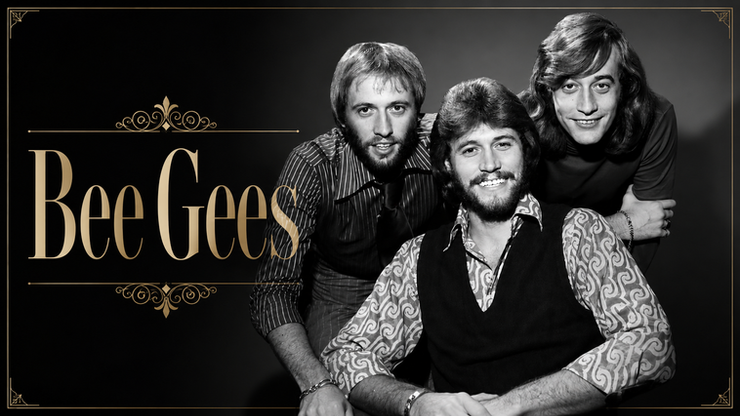
To speak of the Bee Gees is to speak of one of those musical stories that seem straight out of a movie. Barry, Robin, and Maurice Gibb did more than form one of the most important groups in music history; they also experienced a career marked by success, stylistic changes, differences between brothers, and, above all, a musical connection that has rarely been repeated. When I think of them, the first thing I remember is that very distinctive way they had of singing together, as though their voices were one.
The three brothers were born into a family deeply connected with music. Barry was born in 1946 on the Isle of Man, while twins Robin and Maurice were born in 1949. Their father, Hugh Gibb, was a musician who worked as a bandleader and drummer, so they were surrounded by instruments, songs, and stages from childhood. That closeness to music began to show very early. The brothers constantly sang together and even used guitars made from boxes while imitating artists they admired.
When the family moved to Australia in 1958, the boys began taking music much more seriously. They played wherever they could, from small theaters to bars and clubs, and gradually began attracting attention. The story of the name Bee Gees also has a curious detail. Before becoming the group we know, they used different names such as The Rattlesnakes, Wee Johnny Hayes and the Bluecats, and BG's. They finally arrived at Bee Gees, related to Brothers Gibb.
I have always found it interesting that their beginnings were anything but glamorous. Before the big stages and multimillion record sales, the brothers had to sing in small places and often in quite modest conditions. The group’s own history recounts that they performed in bars where water even fell onto the stage while they kept playing. That period was important because it was where they learned to work as a true unit and trust completely in their own voices.
In 1967 came one of their first major international breakthroughs. With songs like “New York Mining Disaster 1941,” “To Love Somebody,” “Massachusetts,” and “Holiday,” the Bee Gees proved they were no one-song band. Their sound in those years featured highly elaborate harmonies, orchestral arrangements, and intense lyrics. “To Love Somebody,” for example, became a classic performed by numerous artists and, over time, one of Barry and Robin Gibb’s most recognized compositions.
But the Bee Gees’ story was not perfect. As often happens between brothers who spend their entire lives working together, there were also arguments, creative differences, and moments when it seemed their professional relationship would not continue. They briefly split up and later reunited. In that process, they demonstrated something that became one of their greatest strengths: they knew how to reinvent themselves.
And then came the period that changed everything.
In the mid-seventies, the Bee Gees began moving much more strongly toward the disco sound. Songs like “Jive Talkin'” and “You Should Be Dancing” marked an important change in their career. Then came “Saturday Night Fever” in 1977, and the group entered an entirely different dimension. For me, it is impossible to speak of the Bee Gees without thinking of that period, because that was when they became one of the biggest names in popular music worldwide.
What is impressive is that several of the hits associated with that film were written by the Bee Gees themselves. “Stayin' Alive,” “Night Fever,” “How Deep Is Your Love?,” and “More Than a Woman” formed part of a soundtrack that became a cultural phenomenon. The “Saturday Night Fever” album was a gigantic success and went on to win the Grammy for Album of the Year.
There is something that has always caught my attention about the group: the quality of their harmonies. Many artists record one voice first and then add the others. The Bee Gees often did exactly the opposite. Barry, Robin, and Maurice could stand in front of the same microphone and build the harmonies together. That habit came from their childhood and became an essential part of their sound.
And although many people remember them only for disco music, that would capture only part of their story. The Bee Gees were extraordinary songwriters and wrote songs for other artists that became major hits. Among them are “Woman in Love” for Barbra Streisand, “Heartbreaker” for Dionne Warwick, “Islands in the Stream” for Kenny Rogers and Dolly Parton, “Chain Reaction” for Diana Ross, and “Immortality” for Celine Dion.
In fact, for me, that songwriting facet is one of the most impressive things about their career. The Bee Gees did not depend solely on their own group. They could write with other voices in mind and adapt their songs to different performers. That shows just how deeply they understood music and the emotions behind a melody.
Another fact that says a great deal about their level as songwriters is that they managed to write, produce, and record six consecutive singles that reached number one, something the group’s official website highlights as a record in pop history.
I also find the way they worked in the studio fascinating. They did not need a complicated formula to begin a song. They could start with a simple rhythm, a melodic idea, or a phrase and spend hours building the song among the three of them. Barry could play the guitar, Maurice work on the keyboards, and Robin contribute melodic ideas and lyrics. They often recorded those first ideas so they could return to them later and find the song hidden within the improvisation.
Of course, behind all that music were three very different personalities. Barry tended to be more reserved and ambitious, Robin had a more imaginative personality and a strong inclination toward writing, while Maurice was known for his fun-loving character. That difference in personalities was also part of the group’s identity. They did not always agree, but that very mix of personalities helped produce very rich music.
Over the years, the Gibb family would also experience very painful moments. Maurice died in 2003 and Robin in 2012. Barry remained as the only one of the three brothers who formed the main core of the Bee Gees. Despite everything, their music continued to grow among new generations, and the group’s stature remained intact.
The Bee Gees entered the Rock and Roll Hall of Fame in 1997, an honor that summed up their weight in music history. The institution highlights that the group remained together for more than four decades and sold over 200 million records, figures that help explain the scale of their legacy.
When I listen again to songs like “How Deep Is Your Love,” “Words,” “I Started a Joke,” “To Love Somebody,” or “How Can You Mend a Broken Heart,” I always have the feeling that the Bee Gees were much more than a group associated with one era. Their music could speak of love, pain, nostalgia, and also fun, and they could move from a deeply emotional ballad to a dance song without losing their identity.
I believe that is the real reason the Bee Gees remain special. They were more than successful; they were versatile. They knew how to change when music changed, endured difficult periods, reinvented themselves, and managed to stay relevant for decades. And behind all of that were three brothers who discovered as children that together they could do something that would never have sounded the same separately.
For me, listening to the Bee Gees is also a reminder that some voices seem made to stay together. Barry, Robin, and Maurice Gibb found that combination when they were very young and spent much of their lives perfecting it. That is why, so many years later, their songs still sound familiar, emotional, and surprisingly current.
The Bee Gees were more than the kings of a disco era. They were musicians, songwriters, producers, and, above all, three brothers who left one of the deepest marks in the history of popular music.