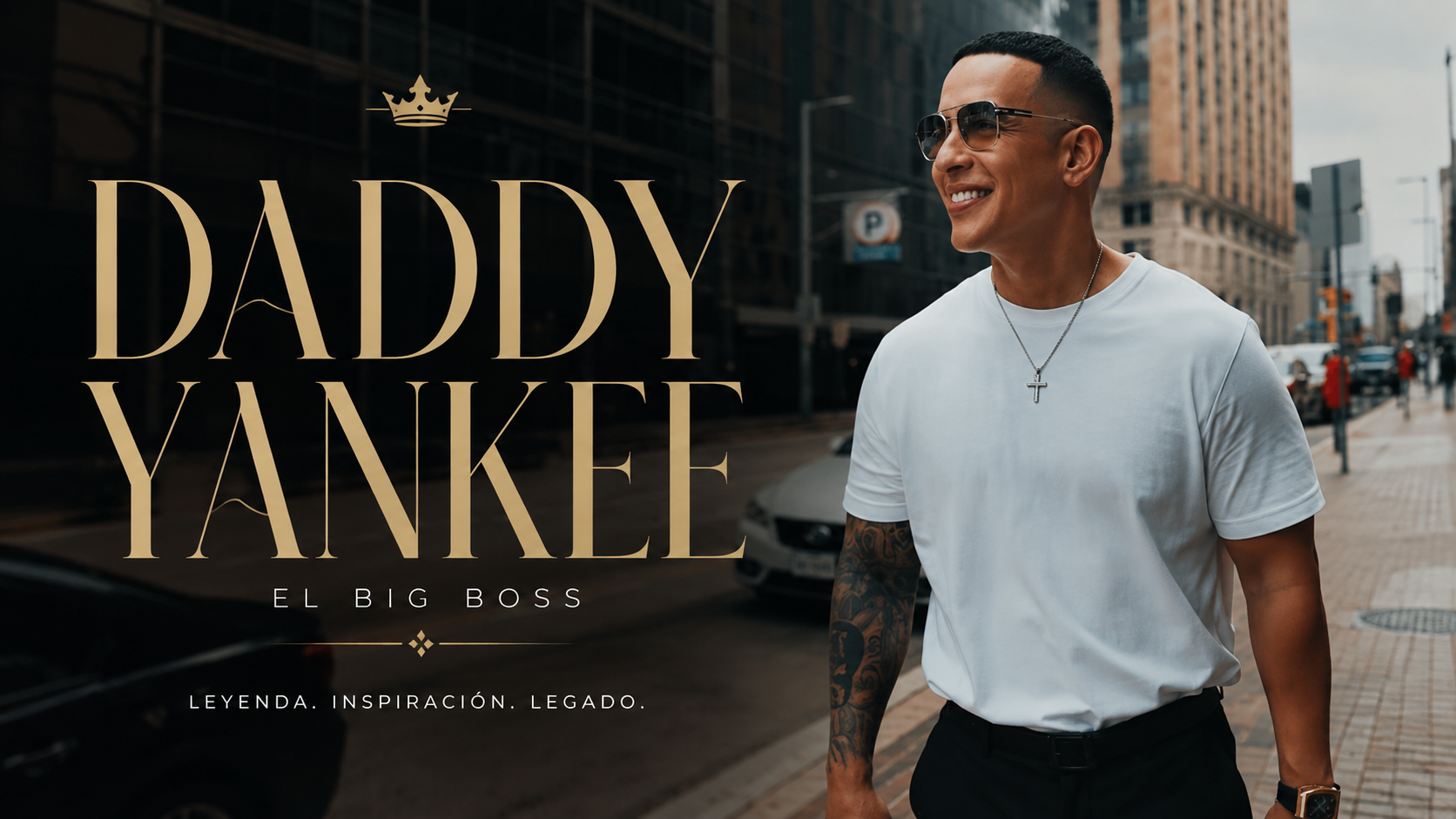
When you think of Daddy Yankee, the first thing that comes to mind is the artist: sunglasses, onstage energy, “Gasolina”, major concerts, and the persona known for years as the “Big Boss”. But when you get to know Ramón Luis Ayala Rodríguez a little better, you understand that behind Daddy Yankee lies a much more complicated, human, and often painful story.
I have always been struck by that difference between the man and the persona. Ramón seems much more private than Daddy Yankee. In fact, through much of his career, he did everything possible to keep his family away from the spotlight. He has explained himself that he considers his family a treasure and therefore prefers to keep certain things to himself.
And perhaps that is one of the first things you understand when approaching his story: not everything Ramón Ayala has experienced is in his songs.
Before Daddy Yankee, there was Ramón
Ramón Luis Ayala Rodríguez was born on February 3, 1977, in Río Piedras, San Juan, Puerto Rico, and grew up among communities such as Villa Kennedy and Las Lomas. His father, Ramón Ayala, was a salsa percussionist, so music was part of the family atmosphere. Yet, interestingly, music was not his first great dream.
His true obsession was baseball.
As a child, he dreamed of becoming a professional player and took that goal very seriously. Years later, he even tried his luck with the Seattle Mariners. Discussing this part of his life reveals something important: Ramón did not begin by thinking he would one day become a global reggaeton star. For a long time, he wanted to be a baseball player.
A child who grew up seeing things beyond his years
There is a part of his childhood that often remains hidden behind his musical success.
In interviews, Daddy Yankee has spoken about growing up surrounded by social problems, violence, and difficult family situations. He has also said his father struggled with alcoholism and seeing him ill was particularly hard during childhood. He has described his mother as a strict woman who taught him to stay strong and overcome difficulties.
I find that contrast essential to understanding him.
Because when you see the man who later became a global superstar, it is easy to imagine he was always destined for success. But his story shows exactly the opposite. There were moments when he was not even sure which path he would take.
Baseball ended in a way no one expected
One episode completely changed his life.
When he was around 17, Ramón was caught in a shootout and shot in the hip area with an AK-47 rifle. The injury was so serious that he risked losing his leg and had to undergo a long recovery. The bullet remained lodged in his body.
The paradox is striking: the event that practically ended his dream of becoming a professional baseball player was also what ultimately pushed him definitively toward music.
He has explained himself that until then, music had been more of a hobby. After the shooting, his life took another direction.
I find this one of the most powerful parts of his story because it shows that sometimes life forces you to change paths before you are able to decide for yourself.
Daddy Yankee began in apartments and on cassettes
Long before full stadiums, international tours, and million-dollar contracts, there was a young man making music in Puerto Rico's underground.
At 13, he began rapping and connected with DJ Playero. Since he lacked the resources to enter professional studios, the music was made practically by hand. The movement's early years were closely linked to apartments, working-class neighborhoods, homemade mixes, and cassettes circulating among young people.
That detail greatly changes how we see Daddy Yankee.
He did not arrive in reggaeton when it was already popular.
He helped build it when no one yet knew how far it could go.
A fact few people know: he tells how the word “reggaeton” was born
This is one of his career's most curious stories.
In an interview years later, Daddy Yankee explained that he had the opportunity to name the genre during a recording with DJ Playero. According to his account, the word “reggaetón” appeared on one of Playero's tapes and arose as wordplay involving “reggae” and the Spanish augmentative.
Interestingly, that name born in the underground ultimately identified one of the planet's most influential musical genres.
And when asked years later how he felt the first time he heard reggaeton, his answer was practically a statement of principles: he did not see it as something discovered from outside, but something he had helped build from the beginning.
Being Daddy Yankee was not always easy
There is a mistaken idea that fame simply came to him.
It did not.
Urban music in Puerto Rico had to fight for years against prejudice, censorship, and social rejection. Early reggaeton was associated with neighborhoods and a culture many sectors considered problematic. Recordings circulated on cassettes, and much of the scene existed practically outside the traditional industry.
That is why the success of Barrio Fino in 2004 meant much more than selling records.
It proved that a sound born in humble spaces could conquer the world.
And there came “Gasolina”.
“Gasolina” changed the story
When “Gasolina” arrived, Daddy Yankee ceased being merely an important figure in the urban movement and became an international star.
Barrio Fino became one of the fundamental records of twenty-first-century Latin music. The Latin Recording Academy notes that it sold more than eight million copies and spent 24 consecutive weeks at number one on Billboard Top Latin Albums.
But there is something I find even more interesting: he did not arrive alone.
He has always recognized the role of other pioneers such as DJ Playero, DJ Negro, DJ Nelson, and many other artists and producers who helped lay the genre's foundations.
That says a lot about his understanding of history.
Because Daddy Yankee may be one of reggaeton's biggest faces, but he knows perfectly well that before the stadiums, an entire community was building that sound.
The man who became a father while still a child
Another part of his story I find very important, often overshadowed by fame, is his experience as a father.
Daddy Yankee became a father for the first time at 17. He has described that period as one of the hardest trials of his life because, in his own words, he was still a child facing an enormous responsibility.
That helps explain why family has always been so important in what he says.
Fame came later.
First, he had to learn to grow up.
His more private side
Something I have always found curious is that despite living under the cameras for decades, Daddy Yankee has been quite careful with his privacy.
He is not one of those artists who turns absolutely every aspect of his life into public content. For many years, he kept his children and much of his family life away from interviews and the press.
That also explains why many people know far more about the “Daddy Yankee” persona than the man Ramón.
And perhaps he prefers it that way.
Baseball never disappeared
Although his sporting career ended tragically, Ramón never stopped loving baseball.
Years later, when he was already one of Latin America's most famous artists, he still spoke enthusiastically about Puerto Rican players and the sport. In an interview with MLB, he discussed his favorite players and his view of baseball.
It is one of those small things that help reveal the man behind the persona.
Before being “El Big Boss”, he was simply Ramón, a boy who dreamed of playing baseball.
That boy never completely disappeared.
Beyond music
Daddy Yankee also developed a business and social side that often takes a back seat.
His name became linked to different projects, investments, and community efforts in Puerto Rico. The Latin Recording Academy particularly highlights his humanitarian work and initiatives connected to education, sports, and support for vulnerable communities. It also mentions his participation in sports projects, including the Cangrejeros de Santurce and the NBA Basketball School in Puerto Rico.
I find this important because it shows how his idea of success changed.
At first, it was about surviving.
Then, about succeeding.
And over the years, he began speaking much more about legacy.
The chapter few expected: faith
Perhaps one of Daddy Yankee's most profound changes occurred after he had achieved practically everything an artist in the genre could achieve.
In 2022, he announced his retirement from professional music. In his farewell, he spoke openly about his Christian faith and a personal need to change his life's priorities.
And there emerges another side of Ramón that is not always understood when his career is viewed only from outside.
After having money, fame, awards, travel, and international recognition, he began speaking far more about purpose, spirituality, and personal transformation.
He did not seem to be seeking another hit.
He seemed to be seeking another answer.
But Ramón still had something more to say
The story did not end with retirement.
In 2025, he returned to music with a new creative chapter linked to his beliefs and messages of purpose. His return included projects such as “Sonríele”, and he subsequently kept appearing on major stages and in collaborations, showing that the artist still had much to express.
And I find that interesting because it shows retiring a version of yourself does not necessarily mean disappearing.
Sometimes it means starting over.
A new chapter after 50
In February 2026, Daddy Yankee turned 50 and spoke publicly about reaching this chapter with a different perspective, marked by gratitude, experience, and life lessons.
And this same year, he received one of his career's most important distinctions: the Latin Recording Academy named him 2026 Person of the Year for his artistic career and humanitarian efforts. The tribute is scheduled for November 11, 2026, in Las Vegas.
After almost three decades in the industry, it is difficult to imagine a more symbolic recognition.
The boy from Villa Kennedy who dreamed of playing baseball ultimately became one of the people who helped take reggaeton from Puerto Rico's neighborhoods to practically every corner of the planet.
My opinion of Daddy Yankee
When I look at Daddy Yankee, I do not see only the man who sang “Gasolina”.
I see Ramón.
I see the boy who wanted to be a baseball player. The young man who was shot and had to change his plans. The son who saw his father ill. The teenager who became a father. The artist who began making music on cassettes and in apartments. The man who protected his family from fame. The businessman. The baseball lover. The believer who decided to change his life's direction.
And above all, I see someone who had many opportunities to remain trapped in his own persona, but decided to keep evolving.
That is what I admire most about him.
Because anyone can learn to live with success.
What is truly difficult is discovering who you are when success stops being enough.
And I think that is precisely the most interesting part of getting to know Daddy Yankee: discovering that behind the “Big Boss” there was always Ramón, a man who had to learn to get back up every time life changed the game on him.