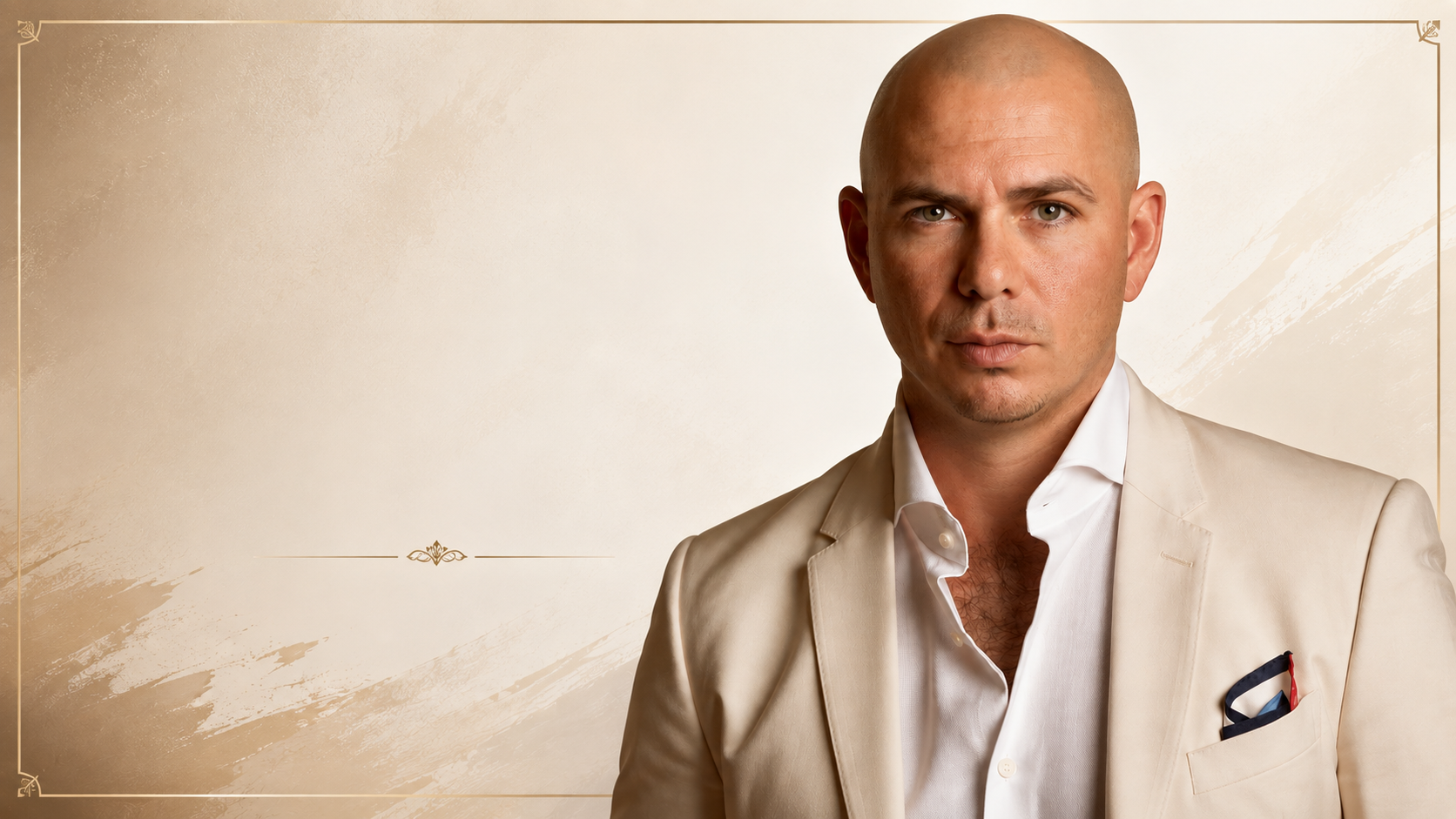
Who Pitbull is and how his story began
Talking about Pitbull means talking about Miami, hard work, music, and a story of overcoming challenges that began long before the world knew the name Mr. Worldwide. His real name is Armando Christian Pérez, and he was born on January 15, 1981, in Miami, Florida, into a family of Cuban origin. Over the years, he became one of the most internationally recognized Latin artists, but before reaching major stages, he faced a rather complicated childhood and adolescence.
Pitbull has always kept his roots close. Miami is not simply the city where he was born, but an essential part of his identity. The Cuban influence, the streets, the mix of cultures, and the city's atmosphere ultimately shaped his speech, personality, and music. When he mentions the famous 305 in his songs, he is referring to Miami's area code, a place that means a great deal in his story.
Pitbull's childhood and Cuban roots
Pitbull's family life had difficult moments from childhood. His parents separated while he was still little, and his mother, Alysha, had to take responsibility for much of his upbringing. His family had Cuban roots, and that cultural heritage was present throughout his life.
One experience that greatly influenced his development occurred in childhood, when he temporarily stayed with a foster family in Georgia. He also grew up hearing stories and lessons about Cuba and important figures in Cuban culture.
One detail from his childhood helps explain where his ease in communicating in front of others came from. His father took him to bars and had him recite José Martí's poems. From an early age, he encountered audiences and learned the power words can have when used to capture other people's attention. Years later, that ability would become one of his main tools as an artist.
Armando Pérez's difficult adolescence
Pitbull's adolescence was not easy either. He has spoken about the problems he faced in his youth and his involvement in activities linked to drug trafficking. Far from romanticizing that period, over the years he has acknowledged that he could have ended up in a much worse situation.
That part of his life is important for understanding his transformation. Before becoming an international star, Armando Pérez had to make decisions that ultimately shaped his future. Music emerged as an opportunity to change direction and begin building a different life.
The stage name Pitbull is also connected to his outlook on life. He has explained on various occasions that he chose that name because he saw in these dogs a trait he identified with his own personality: the ability to stand firm, fight, and not give up easily.
Pitbull's first steps in music
Before becoming Mr. Worldwide, Pitbull began his career in hip hop. During his early years, he was closely connected to Miami's music scene and the Southern sound of the United States.
One of his first big moments came with the song “Culo”, which attracted attention for its direct style and energy. Gradually, he gained recognition and began working with artists and producers who helped make room for him in the music industry.
Pitbull understood very early that he could not remain confined to one style. His music began combining hip hop, reggaeton, electronic music, pop, and Latin rhythms. That adaptability was one of the keys that would later allow him to become an international figure.
The major hits that made Pitbull a star
Pitbull's career took an important turn when he began releasing songs that could connect with very different audiences. “I Know You Want Me”, “Hotel Room Service”, “International Love”, and “Give Me Everything” helped take his music far beyond hip hop audiences.
“Give Me Everything”, with Ne-Yo, Afrojack, and Nayer, reached number one on the Billboard Hot 100 and became one of his career's biggest hits. From that moment, Pitbull stopped being simply a rapper recognized in the United States and began establishing himself as an international star.
His formula was quite clear. Catchy songs, collaborations with major artists, a highly recognizable image, and an energy that worked particularly well at parties, clubs, concerts, and major international events.
From Pitbull to Mr. Worldwide
The nickname Mr. Worldwide became an inseparable part of his identity. Pitbull achieved something very few artists do: bringing a musical approach that mixed different cultures to audiences around the world.
He worked with artists of very different styles and moved naturally between hip hop, pop, Latin music, and electronic music. His pronunciation in Spanish and English also became an important part of his style.
For Pitbull, music was never just a matter of songs. He also understood the importance of building an identity. The sunglasses, suits, shaved head, the way he walked, his phrases, and his famous “Dale” ultimately formed an image audiences could recognize immediately.
Pitbull's most important collaborations
One of the great features of Pitbull's career is his collaborations. Over the years, he has worked with artists such as Jennifer Lopez, Christina Aguilera, Shakira, Marc Anthony, Enrique Iglesias, Ne-Yo, Usher, and many other important names in international music.
His ability to fit into songs of different styles allowed him to reach audiences who probably would never have heard his early hip hop work.
He also played an important role in “We Are One (Ole Ola)”, the official song of the 2014 FIFA World Cup in Brazil, alongside Jennifer Lopez and Claudia Leitte. That project further strengthened his image as an international artist.
Pitbull and his relationship with Miami
Although his fame grew worldwide, Pitbull never stopped talking about Miami. The city is part of his personal and artistic story.
Miami's multicultural atmosphere was essential to his identity. The Cuban community's presence, Spanish, English, and the influence of different musical genres helped create the style he would later take around the world.
Listening to many of his songs, you find constant references to Miami, his Cuban roots, and his pride in growing up somewhere different cultures coexist daily.
Pitbull's entrepreneurial side
Over time, Pitbull stopped concentrating exclusively on music. He also began developing different business projects and turning his name into an international brand.
He has participated in projects related to entertainment, education, technology, food, and other businesses. His way of working shows that he has always understood an artistic career can grow far beyond records and concerts.
That business vision also explains why his name remains relevant even when music changes and new generations of artists emerge.
Pitbull and his work in education
One side less associated with his image as a singer, but which I consider among the most important, is his work in education.
Pitbull promoted the creation of public schools under the SLAM concept, focused on offering new educational opportunities to students and young people from different communities. The project began in Miami and later expanded to other parts of the United States.
This work has special meaning because of his own experience in adolescence. Pitbull has spoken on various occasions about his difficulties at school and how close he came to dropping out of the education system.
Over time, he decided to use his success to help other young people have opportunities he himself considers essential.
Pitbull's personality behind the cameras
Something that has always stood out about Pitbull is the confidence with which he presents himself to the public. He seems very clear about who he is and what he wants to convey.
His image has not changed much over the years. He retains the elegant suits, sunglasses, direct style, and characteristic way of speaking. In an industry where trends constantly change, Pitbull made his image into a kind of personal signature.
He also has a strong sense of discipline. Beyond the partying and song lyrics, he often speaks about work, preparation, education, business, and perseverance.
Pitbull's personal life
Pitbull has been quite careful with certain aspects of his private life. Although he speaks about his roots and childhood, he does not usually turn every detail of his personal life into a spectacle.
Throughout his career, he has preferred audiences to know primarily the artist, the businessman, and the man who represents Miami and the Latin community. That decision has also allowed him to maintain some balance between his public and personal lives.
In interviews, he usually returns to the same ideas: work, discipline, family, education, opportunities, and gratitude for everything he has achieved.
Pitbull's legacy
When I think of Pitbull, I do not think only of songs such as “Give Me Everything”, “International Love”, “Hotel Room Service”, or “I Know You Want Me”. I also think of the story behind those songs.
Armando Pérez began in Miami, grew up facing difficulties, and ultimately built a career that took him to stages practically everywhere in the world. He was not born Mr. Worldwide. He had to build that persona and, above all, prove he could stay relevant for many years.
His story also demonstrates the importance of knowing how to evolve. Pitbull began in hip hop, then incorporated Latin sounds, electronic music, and pop, and ultimately became one of his generation's most recognizable artists.
Pitbull, much more than Mr. Worldwide
For me, Pitbull's true story lies in Armando Pérez's transformation. The man who grew up in Miami and knew difficulties from a young age ultimately turned his experiences into motivation to build something much bigger.
The sunglasses, suits, “Dale”, and the title Mr. Worldwide are only part of what he represents. Behind that image is a man who took advantage of his opportunities, understood industry changes, and made his roots one of his greatest strengths.
That is why Pitbull remains such a recognizable figure. Not only because of his songs or collaborations, but because he created something few stars achieve: an identity of his own that audiences recognize in seconds.
And perhaps that is the best way to sum up his story. Pitbull did not forget the boy he once was. He took everything he had lived through, good and bad, and made it part of a story that ultimately took him from Miami's streets to becoming Mr. Worldwide.


